
Herbig-Aro Star
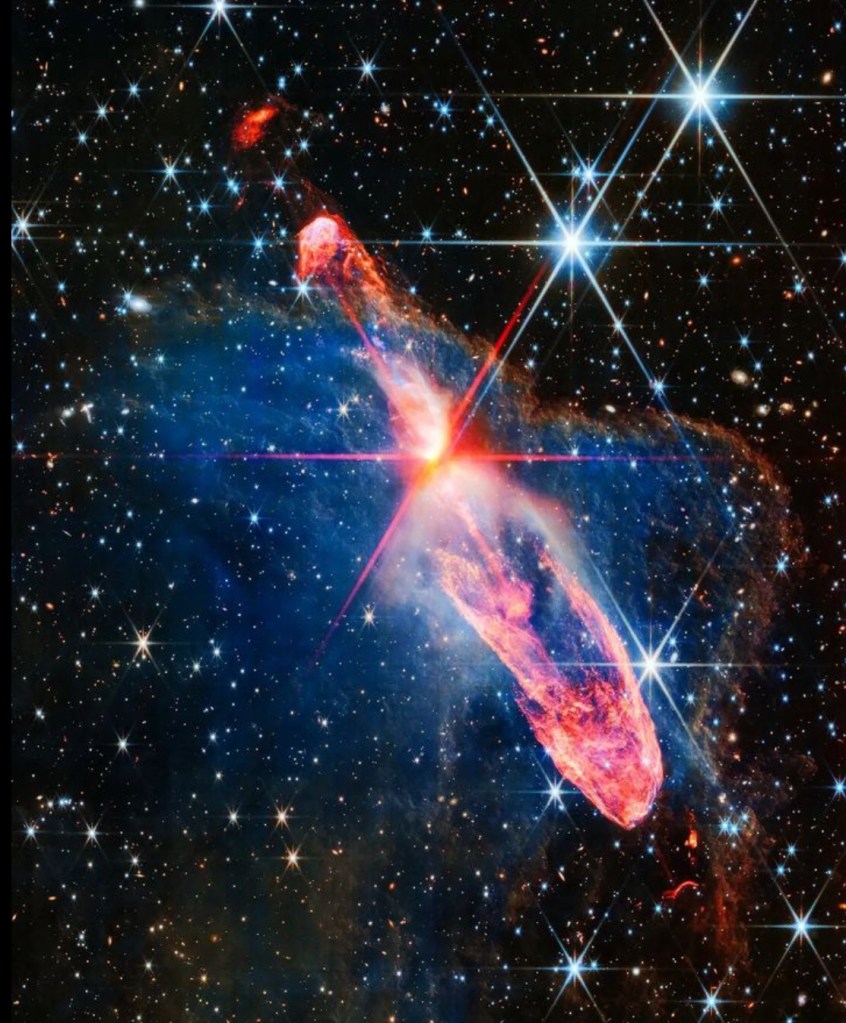
I have no idea how this star was given its name. But, I can’t stop looking at it and wondering are millions of life forms moving around and going through normal life as it is known to them 👽
This star has allot to offer, it’s brilliance although surrounded by a disk of gas. It really caught my eye due to the spectrum of light refraction that is represented here and it’s currently millions of light years away. It amazes me that we are now exploring galaxies, that I physically will never get a chance to see or explore, if not for the JWST, providing Telemetry to us milli-seconds at a time from light years across the galaxy from Lagrange check point. I feel so blessed to be able to see them daily from a much different perspective then what I have posted here. The intellectual side of space is a paradigm of theories and thoughts of views and legacy taught phenomena. What makes sense is that there is rational for some of the colors, the star movement 💫 and bursts of light energy that move across the sky like moving ships carrying passengers to an unknown destination.
The phenomena that has always baffled me is the Kessler Syndrome where the amount of space debris in orbit around earth gets to the point where an increase in collisions cascades, creating more and more space debris, or ‘debris clouds’.

Although with a rising number of space missions by government agencies and private industry, comes a fresh set of problems for Earthlings: potentially dangerous space junk. A recent study published in the scientific journal Nature Astronomy concluded “ that current practices have on order a 10 percent chance of one or more casualties over a decade.”
IN OTHER WORDS, THERE’S ROUGHLY A ONE-IN-TEN PERCENT CHANCE THAT THE NEXT DECADE WILL WITNESS FALLING SPACE JUNK KILL SOMEONE.
But technically that’s just a small problem. Orbiting space debris, is an unfortunate by-product of man’s overall desire to create a microcosm to explore and document space. Is this man’s selfish desire to create a playground for engineers and astrophysicists to work in? Or is it truly the aerospace industry making strives to define the next home for our earths inhabitants once we have truly depleted the ozone layer due to harsh chemicals, such as coal and by-products of the automobile industry pollution aftermath.
We are currently tracking 27,000 pieces of space debris (most are the size of a softball) moving at 100’s of miles an hour with possible trajectories that could enter into our atmosphere with ramifications that could be catastrophic. Luckily most will burn up prior to entering our LEO’s. Are you scared yet? 🫣 I’m glad that this phenomena is someone’s 24/7/365 job to Monitor, Categorize and Review these pieces that come from things like a spent rocket booster or lifeless satellite’s from the 70’s decommissioned or deep spaced for no further use, but will eventually succumb to gravity and return to its rightful producer: PLANET EARTH🌏
-Astro-Nut 👨🏽🚀


 Astro-Nut 👨🏽🚀
Leave a comment